Bibliotherapy: The Eagle on My Arm

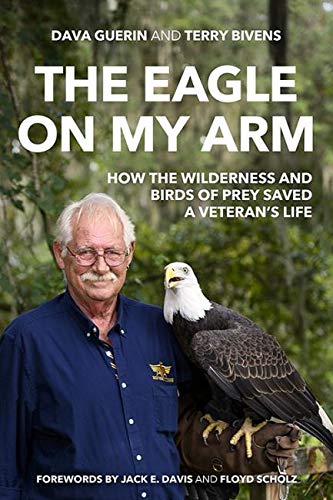
Title: The Eagle on My Arm: How the Wilderness and Birds of Prey Saved a Vietnam Veteran’s Life
Author: Dava Guerin, and Terry Bivens 
Genre: Non-Fiction, Memoir 
Length: 200 Pages 
Publish Date: 2020
Tags/Triggers: Mental Health, Military Service, Suicidal Ideation, Physical Injury, Sexual Assault, Depression, Animal Death, Death 

For months I have anticipated the release of “The Eagle on My Arm”. I was excited to write a post about this book and bibliotherapy benefits of it. What makes this book so difficult for me to write about is how close to home it hits for me. Actually, it is home for me.

“The Eagle on My Arm” is the memoir of my mentor, Patrick Bradley. Patrick is a Vietnam Veteran with severe PTSD. When he first returned from war however PTSD was not well understood and he was just labeled as aggressive and troubled. Fortunately one of the practitioners at Walter Reed was an advocate for those soldiers who were “damaged goods” and pushed for Patrick to be given an opportunity to reintegrate into the civilian world.

Going directly into the public again was not possible, so instead he spent years in the wilderness studying bald eagles. This time in the wild helped him become grounded and develop coping skills. The impact nature had on his journey to healing wouldn’t be fully appreciated however until years later when his son, Skylar, returned from war with his own demons. Patrick did the only thing he knew of to help his son and got him working with birds. It didn’t take long for Patrick to realize just how powerful reconnecting with nature can be.

This book follows his story and includes part of mine. We hope that through sharing our stories and battles it will help reduce the stigma related to mental health and encourage others to seek treatment as well. It also serves as a preface to our next chapter, where we will be opening an ecotherapy center making services increasingly accessible to those with depression, anxiety, trauma-related disorders and other mental illnesses and disabilities because we believe no one should have to face their demons alone.

The Imposter Inside

Have you ever felt like you were a fraud? Perhaps you questioned your own knowledge in your field or position. Maybe you were anxious that someone would discover that you were just “faking it until you make it.” These are all signs of a phenomenon known as IMPOSTER SYNDROME and you are not alone.

This year has been particularly tough for most people as everyone’s lives changed drastically with the pandemic. This has caused even more people to look critically at themselves. Recently, I myself became nearly paralyzed by imposter syndrome. I started a new, temporary, job in the technical theatre industry, which I haven’t worked in in almost 10 years, launched the internship program at Owl’s Nest Sanctuary for Wildlife, and continued on my own professional development journey as a graduate student. Up until now, I had felt rather comfortable, confident even, in my decision to leave my career as a classroom teacher to purse my Big Audacious Goal of opening an ecotherapy center. Suddenly, however, I felt like I must have flown under the radar to get accepted into my graduate program and that I had made it this far by a streak of good luck. I was terrified that any day now my luck would run out and someone would realize that they had made a mistake and I would be busted as an imposter!

So why on earth would I turn around and out myself like this?

Last week I had a conversation with some of my peers, turns out this feeling is pretty universal and most people experience it at some point. Through talking about my feelings I was able to process what was going on deeper within and gained a better understanding as to why this common condition was flaring up so viscously for me.

For many years I had a deeply rooted belief that I was worthless, useless, and undeserving. It wasn’t until the last few years that I was able to start to breakdown these beliefs by reframing my thinking (I will do a post in the future explaining what that means). I spent the majority of my life discounting myself and my achievements because I didn’t feel or think I was worthy of success and recognition. This affected me to the point that if you thanked me for something as simple as setting up the desks for class, I would reject your appreciation and tell you why I did it for self-serving reasons. As a result of this constant self-depreciation, I have a skewed view of my qualifications and abilities but I am working on changing that. I realized that I have spent my whole life trying to prove my worth and not spent enough time reflecting on the value of everything I have done, accomplished.

Yes, I could continue to discount myself by measuring myself against everything I haven’t done, but there will always be more to do and no one is a master of all things. I am choosing to focus on what I have done rather then what I haven’t. As for the “streak of good luck”, Seneca said, “Luck is what happens when preparation meets opportunity”. This means that if I hadn’t put in the work upfront I wouldn’t be able to seize the opportunities I have when they present.

The only imposter is the voice inside telling me I am not worthy and its time that voice shuts up. I’m making a commitment to myself to spend time each week reflecting on something I have accomplished and recognizing myself for the hard work I did to do it. Sometimes these accomplishments may be small but I will write them each down and when the imposter inside begins to creep back up I will have a quick reference of the evidence proving to myself that I am not a fraud, I am a badass!

What is something you have accomplished that you should give yourself more credit for? Comment below and let’s practice some praise with each other!

As an Amazon Associate I earn from qualifying purchases of the items linked in my post.

Uncomfortable Conversations

What does it mean to be racist? Oxford Languages defines racist as “a person who shows OR feels discrimination OR prejudice against people of other races, OR who believes that a particular race is superior to another.” I don’t like this definition. Why, because it forces me recognize that I am racist. I feel incredible shame saying that and fear of the possible pain it may cause. That definition includes a lot of “ors”. I am a person who feels prejudice, a preconceived opinion, about people of other races. These feelings exist as a result of my life experiences and influenced by society.  

I grew up having black friends. In first grade I even asked one of my best friends, who was black, to marry me and I remember attending a biracial wedding (not between two six year old’s). I went to Howard W. Blake High School, a magnet school that adopted the name of one of two all black high schools from Tampa’s past. For those who have never heard of magnet schools, they were designed to encourage desegregation. They do this through offering highly desirable and selective programs so that students who live outside the immediate school neighborhood choose to attend them. The neighborhoods these schools are located in tend to be low social and since our systems remain so broken, many of the residents in these area are black. I choose to attend this school. I fought for two years to get accepted. How could I be racist?  

My senior year I began to explore college opportunities. On my short list was Florida Agricultural and Mechanical University (FAMU). I was drawn to FAMU and wanted to be a part of their amazing music program, but FAMU was historically a university for black students. I was encouraged to look elsewhere because it ‘would not be ‘safe’ for me to go to FAMU. Instead I chose to attend a small community college and then the University of South Florida. Over the years I have had roommates, friends, professors, peers, coworkers, and neighbors who are black. Again, how am I racist? 

Society has told me, repeatedly, that people who are black are riskier than those who are white. That is not to say they are dangerous, but they might be. As a result, objectively I know that race does not determine a person’s ability or character but subjectively my gut alerts me that I should be cautious. I hate that I am racist and I make a conscious effort to change my thinking and not allow it to influence my behavior. I work hard toward making systemic repairs so that racism disappears. I am committed to being an ally and helping to support cultural competency so that we can end these societal influences and racism because black lives matter.  

I am no expert in race, racism, or black culture, but I am dedicated to learning. I will be making a greater effort to gain competency and encourage you to do the same. As I learn and discover resources I will share and reflect using this site. I encourage you to subscribe to my page so that you can take this journey with me. I stand with my community, not in silence, but in shock. We have to take off the blinders of ignorance and address the broken systems so that we can rise together. We need to have these uncomfortable conversations.  

Spoon Allowance: Understanding Life with Chronic Conditions

Depression, anxiety, lupus, and diabetes are a few examples of chronic illnesses. For those who do not live life with a chronic illness it can be incredibly difficult for to understand what it’s like for those with these concerns on a daily basis. Typically when someone is asked to describe what it is like to have any given condition they talk about the medical symptoms but trying to explain the experience itself is a challenge. Christine Miserandino developed the most well-known theory to illustrate what it is like to live with a chronic illness. Her theory is known as spoon theory and gave birth to a community of ‘spoonies’ who connect through their shared experiences with chronic illness.  

So, let’s dive into spoon theory! We all understand that energy is a resource needed to do any task, however energy is not easily quantified. When Christine was asked late one night in a diner by her best friend to describe what living with lupus was like she looked around for anything she could use to demonstrate her experience. She quickly rounded up as many spoons as possible to use, twelve in total. She used each spoon to represent a unit of energy. She explained that most people have a seemingly infinite number of spoons but, those with chronic illness have a limited daily supply. She then walked her friend through a typical day, taking away spoons for each task. While a non-spoonie may think of getting ready in the morning as a singular task, in actuality it is comprised of several tasks- getting out of bed, showering, brushing your hair, putting on cloths, making breakfast, eating, etc. If not careful a spoonie can blow through their spoons in no time and be left without the energy to complete the day. As a result they must budget their resources each and every day and make informed decisions so that they do not end up in a situation that exacerbates things.  

This means that some spoonies frequently have to make sacrifices to make it through the day. This looks different for everyone, while one person may be able to skip a shower and put off their errands for a day others may end up needing to power down for a few days doing the minimum so that their spoons can be replenished. In time spoonies learn what their needs are and how hard they can push themselves. However, no matter how skilled they become at managing their spoons there are numerous factors that out of their control, catching a cold, getting stuck in traffic, or having to defend themselves to those around them.  

I am so grateful that Christine found a way to illustrate what spoonies, like me, experience. While some spoonies are open about what condition(s) they manage not all are, so it is important to respect their privacy. No one should have waste spoons on defending themselves and the reasons they function differently. I encourage all spoonies to take care of themselves first and surround themselves with a community of support and understanding. Also, remember to praise yourself for your accomplishments. What may seem like a small task to an outsider may be a large feat for you when working with limited spoons!  

Whether a spoonie or not, I invite you to subscribe to my site to learn more about mental health and wellness. 

Unpacking the BAG

Recently we have explored setting a Big Audacious Goal (BAG). A BAG should be so large that it seems almost unachievable at first. However with planning and perseverance anything is possible. Today we will unpack our BAG to see what smaller achievable goals are inside and then continue to break these smaller goals down until we have a list of bit sized steps. 

We will start by looking at a BAG and pulling out the goals which are written within it. For this example, I will be using my BAG but encourage you to follow along with your own. 

BAG: I will open an ecotherapy center (1) that offers a variety of mental wellness services that integrate traditional practices as well as nature assisted therapies. It will provide out-patient (2)partial hospitalization (3), and residential programs (4) as well as consultations (5) and programs for the general public (6) 

As I begin to unpack my BAG I am able to identify six goals that are stated within it. 

  1. open an ecotherapy center 
  2. out-patient mental wellness services 
  3. partial hospitalization mental wellness services 
  4. residential mental wellness services 
  5. consulting 
  6. public programs 

Looking at these six goals, they are still rather big, but as individual goals they are not as audacious. In order to make progress to these goals they need to be broken down even further into the smaller goals that must first be achieved to reach the bigger goal. So let’s breakdown one of these goals further. 

To provide out-patient mental wellness services I need to become a Licensed Mental Health Counselor. I am planning to remain in Florida so the goals I have listed within this goal are linked to the Florida licensure requirements. These goals include: 

  • Graduate from a masters level mental health counseling program that is accredited by CACREP (In Progress
  • Complete 1500 Face to Face and 100 supervision hours as a Registered Intern 
  • Pass the National Clinical Mental Health Counseling Examination 
  • Complete the Rules & Laws Course (8 hours) 
  • Complete the HIV/AIDS Course (3 hours) 
  • Complete the Domestic Violence Course (2 hours) 

While these seem much more reachable they could be separated into even further, smaller goals, such as the course work required to obtain the masters degree and then even further into the tasks and assignments within each course. Each person’s need to break down their goals into bite sized bites will vary and for spoonies, like myself (there will be a post about spoonies in the future), sometimes we need to break our list all the way down to each tiny step. Stephen Duneier explains it while in his TedX Talk when he breaks down his goal to hike 33 trails down to each and every action, including putting down the remote. 

Writing this post in just one of the tiny steps I take on my journey to reach my BAG. What is one of the steps you are taking to reach your BAG? Share it in the comments and subscribe to my blog for more content to help you live with mental wellness on your journey.  

Website Powered by WordPress.com.

Up ↑