Spoon Allowance: Understanding Life with Chronic Conditions

Depression, anxiety, lupus, and diabetes are a few examples of chronic illnesses. For those who do not live life with a chronic illness it can be incredibly difficult to understand what it’s like for those with these conditions on a daily basis. Typically when someone is asked to describe what it is like to have any given condition they talk about the medical symptoms but trying to explain the experience itself is a challenge. Christine Miserandino developed the most well-known theory to illustrate what it is like to live with a chronic illness. Her theory is known as spoon theory and gave birth to a community of ‘spoonies’ who connect through their shared experiences with chronic illness.  

So, let’s dive into spoon theory! We all understand that energy is a resource needed to do any task, however energy is not easily quantified. When Christine was asked late one night in a diner by her best friend to describe what living with lupus was like she looked around for anything she could use to demonstrate her experience. She quickly rounded up as many spoons as possible to use, twelve in total. She used each spoon to represent a unit of energy. She explained that most people have a seemingly infinite number of spoons but, those with chronic illness have a limited daily supply. She then walked her friend through a typical day, taking away spoons for each task. While a non-spoonie may think of getting ready in the morning as a singular task, in actuality it is comprised of several tasks- getting out of bed, showering, brushing your hair, putting on cloths, making breakfast, eating, etc. If not careful a spoonie can blow through their spoons in no time and be left without the energy to complete the day. As a result they must budget their resources each and every day and make informed decisions so that they do not end up in a situation that exacerbates things.  

This means that some spoonies frequently have to make sacrifices to make it through the day. This looks different for everyone, while one person may be able to skip a shower and put off their errands for a day others may end up needing to power down for a few days doing the minimum so that their spoons can be replenished. In time spoonies learn what their needs are and how hard they can push themselves. However, no matter how skilled they become at managing their spoons there are numerous factors that out of their control, catching a cold, getting stuck in traffic, or having to defend themselves to those around them.  

I am so grateful that Christine found a way to illustrate what spoonies, like me, experience. While some spoonies are open about what condition(s) they manage not all are, so it is important to respect their privacy. No one should have waste spoons on defending themselves and the reasons they function differently. I encourage all spoonies to take care of themselves first and surround themselves with a community of support and understanding. Also, remember to praise yourself for your accomplishments. What may seem like a small task to an outsider may be a large feat for you when working with limited spoons!  

Whether a spoonie or not, I invite you to subscribe to my site to learn more about mental health and wellness. 

Unpacking the BAG

Recently we have explored setting a Big Audacious Goal (BAG). A BAG should be so large that it seems almost unachievable at first. However with planning and perseverance anything is possible. Today we will unpack our BAG to see what smaller achievable goals are inside and then continue to break these smaller goals down until we have a list of bit sized steps. 

We will start by looking at a BAG and pulling out the goals which are written within it. For this example, I will be using my BAG but encourage you to follow along with your own. 

BAG: I will open an ecotherapy center (1) that offers a variety of mental wellness services that integrate traditional practices as well as nature assisted therapies. It will provide out-patient (2), partial hospitalization (3), and residential programs (4) as well as consultations (5) and programs for the general public (6).  

As I begin to unpack my BAG I am able to identify six goals that are stated within it. 

  1. open an ecotherapy center 
  2. out-patient mental wellness services 
  3. partial hospitalization mental wellness services 
  4. residential mental wellness services 
  5. consulting 
  6. public programs 

Looking at these six goals, they are still rather big, but as individual goals they are not as audacious. In order to make progress to these goals they need to be broken down even further into the smaller goals that must first be achieved to reach the bigger goal. So let’s breakdown one of these goals further. 

To provide out-patient mental wellness services I need to become a Licensed Mental Health Counselor. I am planning to remain in Florida so the goals I have listed within this goal are linked to the Florida licensure requirements. These goals include: 

  • Graduate from a masters level mental health counseling program that is accredited by CACREP (In Progress) 
  • Complete 1500 Face to Face and 100 supervision hours as a Registered Intern 
  • Pass the National Clinical Mental Health Counseling Examination 
  • Complete the Rules & Laws Course (8 hours) 
  • Complete the HIV/AIDS Course (3 hours) 
  • Complete the Domestic Violence Course (2 hours) 

While these seem much more reachable they could be separated into even further, smaller goals, such as the course work required to obtain the masters degree and then even further into the tasks and assignments within each course. Each person’s need to break down their goals into bite sized bites will vary and for spoonies, like myself (there will be a post about spoonies in the future), sometimes we need to break our list all the way down to each tiny step. Stephen Duneier explains it well in his TedX Talk when he breaks down his goal to hike 33 trails down to each and every action, including putting down the remote. 

Writing this post in just one of the tiny steps I take on my journey to reach my BAG. What is one of the steps you are taking to reach your BAG? Share it in the comments and subscribe to my blog for more content to help you live with mental wellness on your journey.  

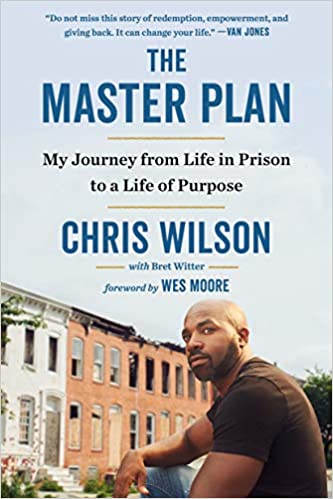
Bibliotherapy- The Master Plan: My Journey from Life in Prison to a Life of Purpose

Title: The Master Plan: My Journey from Life in Prison to a Life of Purpose 

Author: Chris Wilson 

Genre: Non-Fiction, Memoir 

Length: 414 Pages 

Publish Date: 2019 

Tags/Triggers: abuse, addiction, alcohol, bullying, cancer, child abuse, death, domestic violence, drugs, emotional abuse, incarceration, murder, physical abuse, rape, self-harm, terminal illness, violence 

Growing up Chris Wilson witnessed things no child should ever see. His mother was brutalized and descended into addiction. The neighborhood around him became a war zone and he saw people he loved gunned down. After a while he felt like his choices were fight or die. Then one night he did just that and ended up with a life sentence for murder.  

He was very fortunate to be placed at the prison in Patuxent where the youth inmates were housed separate from the adults. Patuxent also had unique opportunities for offenders to participate in educational programs and counseling. Access to this program allowed Chris to begin to heal and formulate his master plan. This master plan answered his burning question, “What’s your endgame?” Even behind bars with a life sentence all people wonder why they are here, on this planet. 

Chris’s plan began as a bucket list filled with experiences such as “grow a big-ass beard” and attending a bull fight. As he continued to heal and learn his plan evolved and became much more purposeful. Even before he could see light at the end of the tunnel he found light in his life through purpose. He worked incredibly hard without the promise of external pay off just “positive delusions”. His hard work eventually did lead to the opportunity of reward and turned his delusions to reality.  

With the support of caring people around him he managed to get his sentence reduced. He was one of the few to reap rehabilatative benefits from his time in prison. When he earned his release he continued to work hard and give back. He has devoted his life outside to helping keep others out. He has developed systems and supports to improve the culture of the neighborhoods that traditionally acted as pathways to prison.  

The Master Plan: My Journey from Life in Prison to a Life of Purpose was an amazing read that was hard to set down. It is a stark reminder of the deep deficits that plague our country. There are huge inequalities that must be addressed and Chris Wilson is working to do just that. His actions should not end with him but should rather act to inspire and influence others to make positive changes.   

As an Amazon Associate I earn from qualifying purchases of the items linked in my post.

Bibliotherapy- Rebuilding Sergeant Peck: How I Put Body and Soul Back Together After Afghanistan

Title: Rebuilding Sergeant Peck; How I Put Body and Soul Back Together After Afghanistan 

Author: John Peck, Dava Guerin, and Terry Bivens 

Genre: Non-Fiction, Memoir 

Length: 216 Pages 

Publish Date: 2019 

Tags/Triggers: Mental Health, Military Service, Suicidal Ideation, Physical Injury, Traumatic Brain Injury 

Born in 1985 to a single mom, John Peck was destined for military service. Throughout his childhood he remained resilient despite repeated physical and emotional abuse, family financial struggles and homelessness. However, he continued to persevere and achieve his dreams. In 2005, Peck joined the Marines. Little did he know just how much it would change his life, in ways he could never have imagined.  

Not long after enlisting, Lance Corporal Peck was sent on his first deployment to Iraq. There he spent his time patrolling the area in order to network with the locals and complete searches to gather intelligence on terrorist cells. During one of these patrols his vehicle rolled over a pressure plate triggering an improvised explosive device (IED). This incident resulted in a traumatic brain injury (TBI) that promptly ended his deployment and nearly ended his military career. 

The TBI that Lance Corporal Peck received caused much more than just momentary confusion. He spent years undergoing evaluations and rehabilitation to learn how to live with the resulting memory and motor damage. With lots of hard work and support, he was able to prove that he was still capable of being a fully functioning Marine with minimal accommodations. In 2009, he reenlisted with the hope of once again being deployed and a year later was sent to Afghanistan.  

On May 24th John stepped squarely on a missed device and instantly lost both legs and his right arm. While his left arm was still attached, it was severely injured which would eventually result in it too being surgically removed. 

John spent months being stabilized. Every conscious moment, he begged the medical staff to let him die. Between the pain and reality of his new disability he could not imagine there was any purpose in his life. It wasn’t until he witnessed others overcoming similar injuries and living fulfilling lives that he began to see a future for himself as well.  

He began to build his network of support, and the more people he connected with the more meaning he saw in his life. When he realized that leaving his darkness behind was helping others do the same, he became even more motivated to regain his independence. As he began to be an active participant in his treatment, he earned a new rank: Sergeant. In this leadership role, he reflected on all the trauma he had overcome thus far and was determined to dig within himself and awaken that same perseverance and resilience he’d had as a child. John began to advocate for himself and take his new challenges head on, leading to his to becoming the first successful recipient of a double arm transplant. 

Rebuilding Sergeant Peck; How I put Body and Soul Back Together After Afghanistan reminds us that despite the complexities that come with managing disabilities everyone is capable of living a fulfilling and purposeful life. It is a great read for anyone facing challenges in their lives be they physical, such as the loss of a limb, or mental, such as depression and anxiety. I recommend it to anyone who is looking for an inspirational page turner. “Rebuilding Sergeant Peck; How I put Body and Soul Back Together After Afghanistan” challenged me to look for opportunities for growth within problems I experience and to recognize that life is more than the events that make it up. It is okay to feel despair in the face of suffering, yet remember that it is only a part of your story. Life doesn’t always happen the way we expect, and living with that uncertainty is something we all have face.  

As an Amazon Associate I earn from qualifying purchases of the items linked in my post.

Website Powered by WordPress.com.

Up ↑