Contingencies and Consequences; Whats in it for me?

Everything we do, we do for a reason. We may not intuitively recognize what the function of our behavior is, however through reflection and analysis we can often get to the root cause. Our brain is like a massive spreadsheet and every experience we have is a line of data. The data includes countless amounts of information but at the 10,000 foot view most of the data can be classified into two broad categories- contingencies and consequences.

A contingency is an if/then relationship or cause and effect. Most outcomes are contingent on some preceding input and future responses informed by previous outcomes (consequences). In the two major learning processes these responses can become reflex or automatic, classical conditioning, or intentional, operant conditioning.

You have likely heard of Ivan Pavlov and his famous drooling dogs. Pavlov first described the process of classical conditioning when he was studying the physiology of dog digestion.  To boil it down, he observed that when he rang a bell consistently prior to providing food to the dogs in his study they began to associate the bell with the delivery of food. The presentation of food regardless of the bell resulted in the dogs salivating. Over time, the bell became so strongly associated with the presentation of food that even the sound of the bell in isolation resulted in the dogs salivating. This behavior had become automatic and was not a conscious decision made by the dogs but rather a learned reflex, because the data showed that IF the bell rang THEN food would be presented.

A less well known scientist in mainstream populations, psychologist B.F. Skinner described the process of operant conditioning. Operant conditioning differs from classical conditioning because it is based on how the subject operates on or interacts with their environment. Skinner did a number of experiments exploring how rats responded to and changed the way in which they operated inside a box based on their previous experiences. He designed his boxes with built in contingencies, for example IF a lever is pushed THEN food is presented. Unlike Pavlov’s pooches, Skinner’s rats controlled the IF. The rats learned that their actions (IF) had a direct impact on outcomes (THEN or consequence).        

Consequences are the results of an action. They are the ‘then’ in our contingent relationships. Consequences are data that influence how we operate on our environment or make decisions in the future. When discussing consequences scientifically we label them based on two criteria: the first is the manner in which they impact future responses, increase, decrease or have no change to the frequency of the response, and the second is based on whether the consequence adds or removes something from the environment or person.

Let’s start by looking at the first criteria, how the consequence impacts future responses. When a consequence is something desired and likely to increase the chances that the same behavior will occur in order to access the consequence in the future it is said to be reinforcing. These consequences strengthen or reinforce the chance that a behavior is repeated under the same or similar circumstances in the future.  When the consequence is aversive or undesired and it’s likely to reduce the chance that the same behavior will be repeated in the future it is said to be punishing. To determine if a consequence is reinforcing (desired) or punishing (aversive) you ultimately have to evaluate the impact it has on the individual’s likelihood of repeating the behavior in the future. One of the things that is so fascinating about the study of behavior is that each individual is, well, an individual. A consequence that one person finds reinforcing, another may find punishing and even within the context of where and when the consequence occurs or who and how it is delivered can change its impact on the same individual. Here is an example of a consequence (slapping) and how its impact may vary based on the context:
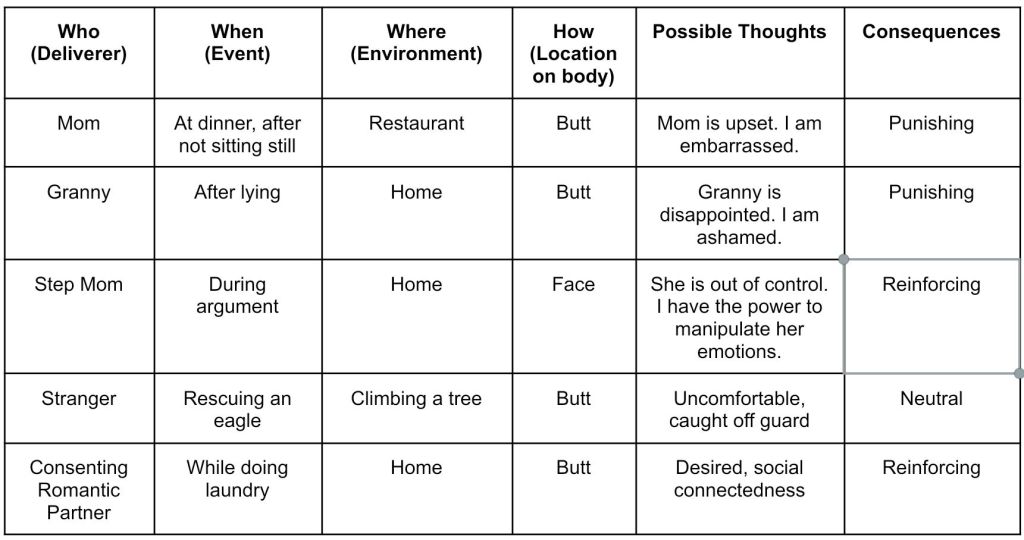


Keep in mind the examples above are from my personal perspective of being on the receiving end and the same situations may have different impacts for you.

The next criteria that is evaluated when describing consequences is if the consequence adds or removes something from the environment or person. When the consequence adds something we say it is positive (adding) and when it removes something we say it is negative (subtractive). This criteria can also seem to contradict itself as the addition of one thing may remove another or visa versa.
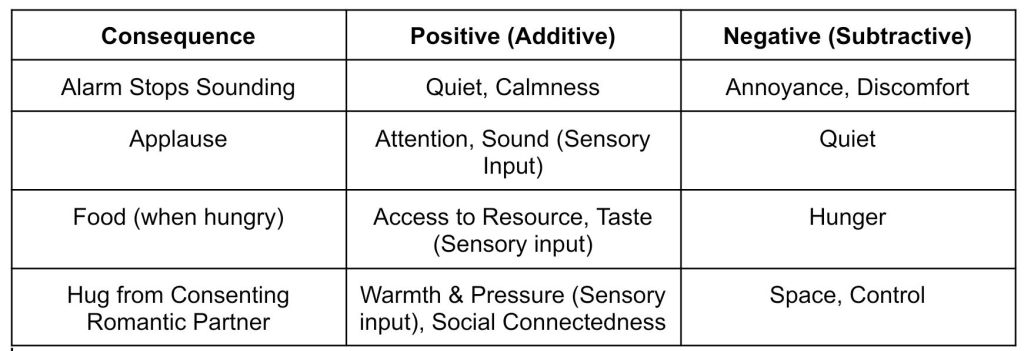

While we define the first criteria based on its impacts on the receiver, the second criteria is typically defined based on the intention of the deliverer, but we should always remember the balance of give and take when evaluating behavior modification and the function or reason a consequence drives the behavior.

Now we can explore a few examples of an everyday contingency, the consequences and how they could impact behavior.

Contingency/Scenario Part 1: IF a seat belt is not buckled THEN a repeating beep of increasing volume will begin.

Person A: This is intended to be aversive and disruptive for most people, by adding an unpleasant sensory experience and is designed to decrease the likelihood that a person remains unbuckled. At this moment it would be described as positive, adding an auditory element, punishment decreasing the likelihood that the person stays unbuckled.

Person B: A child in my life finds the repeated escalating beeps to be a desired auditory input. This results in the same contingency having much different consequences. In this instance the addition of the beep is desired and therefore likely to increase the probability that he will leave off or disconnect his seat belt so it would be said to be positively reinforcing the behavior of remaining unbuckled.

In both of these examples the consequence of the beep is added making it positive but the impact changes based on the person.

Contingency/Scenario Part 2: IF you buckle your seat belt THEN the alarm ceases.

At this moment the alarm stopping would be described as negative, however once again its impact differs based on the person, changing the way it is described.

Person A:  The removal of the undesired sound increases the likelihood that they wear their seatbelt in the future, negatively reinforcing the behavior of wearing a seat belt.

Person B: The beep stops and he loses access to the desired sensory input and decreases the chance that he will leave his seat belt on. In this case the beep ceasing would be described as being negative punishment as it uses the removal of a consequence, the beep, to reduce the behavior, wearing his seat belt.

Now I want to introduce a third person and result:

Person C: Granny’s hearing aids are dead and she is unaffected by the beeping. In this case it would not have an impact and therefore be neutral as it would not effect a change in her behavior.

When you are evaluating behavior, think about what contingencies there are and the consequences that occur. As we move forward in this series on behavior science we will look even closer at the complexity of contingencies and consequences. When we are learning science we start by learning the most simplistic, black or white parts however this world is not black and white, it is full of color and so is science. Science is so much more complex than this or that and behavior science is no different. Oftentimes we have to collect data, reevaluate,  hypothesis, test and repeat. Even though the science is simple, the practice isn’t always easy but the benefits to modifying behavior in positive ways is worth the effort you apply.


What is Driving Your Behavior?

Regardless of my job title, there is one fundamental aspect that seems to be a through thread and that is understanding behavior. What is behavior exactly? Behavior is the observable and measurable things that an organism does, in this post we will be talking about people. Most behaviors that come to mind first are overt, or able to be easily observed by others, behaviors can also be covert and only easily observed by the individual doing them, such as thinking. Every behavior serves a purpose or function that can be linked back to our basic needs. 

In 1943, psychologist Abraham Maslow theorized a hierarchy of needs in his paper “A Theory of Human Motivation”. He presented these needs as a tiered system and hypothesized that in order for higher level needs to be addressed, lower level needs must first be fulfilled. The most basic of needs include our physiological needs such as air, nutrition, hydration, rest, temperature regulation and waste removal. These basic needs are required to maintain life in general but as we begin to move up the hierarchy the needs increase the quality of life. The next level addresses our safety needs; these include access to resources, shelter, control, structure, etc. Once we feel safe and secure we can focus on our social needs like a sense of belonging, community, connection, friendships, and intimacy. With connection and a sense of love and belonging we begin to develop our self-esteem and everything beyond that which includes growth and self-actualization. It was initially theorized that these needs had to be met at each level before progress at the next level could occur, however, as we have learned progress is not linear and multiple levels can be addressed simultaneously or even compete with each other.   

Behaviorists use the term function to describe the reason a behavior occurs so lets see how these needs fall into place with these functions. The four functions are access to resources, attention, escape, and sensory. When teaching animal trainers how behavior works many of them get stuck on access to resources and specifically nutrition. As we will be exploring, what drives our behavior is much more complex than just food, and we will start by unpacking what all access to resources includes. 

When discussing access to resources as a function of behavior we are talking about tangible items that move us toward fulfilling some of those basic needs including physiological needs (nutrition, hydration, thermoregulation), social needs (other individuals or groups), self-care (bathing, clean clothes, comfortable place to rest) and even growth (entertainment and learning). 

The next function we are going to explore is attention. Attention addresses the need for social connectedness and for people is most frequently desired from other people. Attention could be presented in various different ways, visual attention such as being observed or watched by others or interactions online, auditory attention like applause or cheering, and even social as in being included or sharing space. 

Both attention and access to resources could also fulfill a sensory function. When we talk about sensory we mean pleasure and pain. This can occur through any of the senses; things we hear, see, taste, smell, and or touch. 

The final function is escape. Escape can happen in opposition to any of the previous functions we discussed. Escape is when we are attempting to avoid something that we find aversive or to simply exert control.

When we understand these functions we are able to better analyze the reason(s) a behavior occurs and potentially identify ways in which we can modify our behavior. In the future I will be diving deeper into the science of behavior and attempting to make it accessible to anyone with an interest. My goal is not to teach you how to manipulate others but rather take control of yourself and work on modifying your own undesired behaviors or forming new positive habitats. I know that some of the science may be a dense read and if you have any questions or would like additional clarification feel free to leave a comment and I will work through it with you.

Holding onto Hope

Happiness and hopefulness are not synonymous. Over the last decade I have fought to maintain hope. There have been several points in my life where all hope was gone and I had given up. There are times when hoping for a specific outcome can be harmful and highly unlikely or even unrealistic, hoping your intimate partner will suddenly change and become less violent in an abusive relationship. At some point I will dive much deeper into the science of behavior and we will explore topics like abuse more then. However, hope is often what drives us to keep going. There are inevitabilities in life, such as death, however to quote the Connors, “The future is not set. There is no fate but what we make for ourselves.”

Having hope is different from being positive and allowing “fate” or “faith” to take control. Blind positivity without the drive to change the future is toxic. Everything isn’t wonderful. Humans are struggling to live safe quality lives, our planet is experiencing extreme changes, and we continue to practice blind toxic positivity. It will all work out, just have faith…

Hope however can drive action. I am disappointed, frustrated, disgusted, worried but hopeful. I believe that we may be losing battles but the war is not over. So how do we make our own fate? By fighting. There are so many ways in which we can continue to fight for a fate we design rather than succumb to whatever may occur if left unchecked.

When we think of those fighting wars, they are people who have agreed to give up everything for their cause, but don’t worry, you don’t have to give your comfort, safety or life to make gains. No one person can single handedly save the world, however, millions of people making small changes can have a huge impact.

The war you choose to battle right now might not even be world impacting yet. There have been times in my life when I had neglected my own needs to the point that I was fighting to stay alive. Some of the small changes that I had to commit to may have been as simple as getting out of my bed everyday, even if that just meant relocating to the couch. Once that became a habitat I could begin working on reconnecting with others or engaging my brain in something other than ruminating. Each little change built up to allow me to get back on my feet.

My current personal war is living MY life. I have spent most of my life taking care of others to the point of sacrificing my own wants and higher needs. Thus far I have done things I enjoy- reading more, dinner or drinks with friends, etc. However, there are many things that feed my passions that I have avoided because others feared for me doing them alone- getting out in my kayak, hiking, and exploring new places. While I would absolutely love to share these adventures with someone, I am going to start doing them for myself even if that means by myself, regardless. I am done forcing myself to be what others want from me and am going to live my life authentically and while doing this hopefully find my people along the way.

People Pleaser Problem

Why did I stop writing? Why did I ever start? 

I started therapy when I was just 6 years old. I don’t remember a ton about the modality or any positive changes that came from that first therapist. I do recall her explaining to me that I could trust her, that she would keep my secrets and help me. And then I remember the backlash and broken trust. She had been subpoenaed to court as a witness in the incredibly vicious custody battle that was just beginning to sink its vindictive claws into my little life. “Family” at the time in history was presented as this happy unit of people who loved each other unconditionally, who stuck together through thick and thin, defended each other and were permanent. I had never heard of a chosen family, had no examples of what divorce was or could look like. I was alone in uncharted territory. 

Divorce at that time was still so taboo that even other authoritative adults in my life weren’t sure how to respond. In school I was pulled from my class weekly by the guidance counselor to monitor how I was coping I guess. I can tell you not well, I recently found one of my notebooks from 1993, when I was 7 years old, and my “art” is disturbing. Why have I held onto it? I guess it is a reminder of who I am and how far I have come. The adults at school weren’t the only ones unsure of how to handle the situation, I was excluded from extra-curricular activities at church. They couldn’t stop me from attending but they could and they did prohibit me from being an active participant in both the youth group and youth choir, isolating me from my peers. 

Other kids didn’t know how to act either. I was taxied back and forth, weekly, between two houses more than 7 miles apart, in two different zip codes, two different school zones, too far to walk or bike between. My father rarely allowed me to go anywhere I was invited during “his time” and very quickly the invitations just stopped altogether. I was again isolated. 

His time was so valuable because that is when he had full control. The ability to say what he wanted without witness, the only reason I can think of even now was to utilize me as a pawn in his war against my mom. To this day I can not fathom how such hate exists. There are people who make me shudder, who cause a visceral reaction, and even people that strike such fear into me that I flee and yet, I can’t find the capacity to hate. I don’t even hate him, even after he erased me from his family tree. 

I sometimes wish that as easily as he omitted me from his records that I could do the same. Undo the neural pathways he laid ever so carefully. Untangle my twisted automatic thinking. However, it is not possible to erase such trauma and now most days I would not give up my past, it has shaped not only my struggles but also informed my victories.

I have however spent years, decades really, trying to learn how to undo the damage and retrain my brain. I have lost count of how many professionals I have seen. Some only once as they did not inspire a sense of safety in me. Others I saw for months or years at a time. The most impactful moment came in 2018 when my psychologist at the time, Dr. Martin Cohen, told me to “stop being so damned selfless”. I immediately began to pile on my self-deprecation and cite how he was right, my father was right, I was selfish and worthless. Selfish for never giving enough, being enough, for anyone, absolutely worthless. Dr. Cohen would not stand down. He immediately met me with a counter argument. As a way to try and overcome the isolation I dealt with for oh so many years I had become a persistent people pleaser. I did whatever everyone else expected from me, pushed down anything I wanted if it didn’t align to what others around me desired. I had given up me, who I really was, my actual authentic self to try and build connectedness, a sense of love and belonging. The problem was no one, not even me, knew me. This person that was trying so hard to not to stay alone, not die alone like she had been told she would so many times, wasn’t actually me. I was still alone and felt that loneliness to my core. 

That realization is what started me on a new journey. I started graduate school and sought out to discover who I was and what I wanted for the first time in a very, very long time. In graduate school I met many people who had demons similar to mine and so I started writing. 

My writing was a form of self discovery, catharsis, and an outstretched hand to anyone else fighting to not just stay alive, but live a life worth living, a meaningful and connected life. I wanted everyone else like me to know that they belong, WE belong and are worthy of connection, love and happiness. 

So why stop? Once again I had forgotten about me. No one was taking my hand and I had fallen into the old habitats of people pleasing and measuring my worth based on the acceptance of others. I forgot why the journey began in the first place. Here I am though, sitting surrounded by people and yet feeling alone, on the beach, watching a pair of dolphins play as the sunsets and crying as I recommit myself to me, rejection be damned. As a coworker recently told me, if people don’t stand by me in the rain, they don’t deserve me when the sun shines either. 

I may not have many friends but I do have a few really great people who love me, real me, actual authentic raw, rainy days included me.  And I am going to try to accept rejection with more grace. Rejection does not reflect on me but so many things and I am going to try to embrace those awkward moments when I reach out to try and build connections and community yet my hand stays empty or gets pushed away. Those people who get to know me and still love me mean so much more than all of the forced false friendships in the world.

Progress Isn’t Linear

Half a decade, 5 and a half years, 66 months, 289 weeks, 2, 022 days. No matter how I measure the length of time between my last post and today it seems unfathomable. So much has changed in my life and yet so many of the same struggles arise and that is not a surprise, not because I am incapable of lasting change, but rather because a straight line does not exist and therefore progress does not occur in a linear (straight) path either. 

A straight line is an abstract mathematical theory.  Look closely at the natural world around you and you will notice that texture, depth, movement, and imperfections exist everywhere, straight lines are an impossibility. Why then would we expect people to be able to achieve the impossible?

As we all move through life we move forward through time which, at least currently, is the only dimension that prohibits movement in any other way. Every other dimension is fluid and therefore like the oceans ebbs and flows, and changes its movement based on gravity, weather, climate, and other external forces. 

Our lives are complex and filled with external forces that impact our ability to move in a linear fashion. We have experiences that may push us forward and encourage us to make massive positive progress, or pull against us forcing us to exert ample effort to hold our ground and sometimes we are able to continue to move forward, while other times these forces cause us to back slide. Initially, these opposing forces appear to do nothing besides fight against us, however it is in the moments of adversity that we are able to hone our tools and skills to better be equipped for future challenges. While we are able to strengthen our response no amount of practice and positive progress will put an end to these trials.

In the last 5 years my waters have provided me with monumental momentum to make some positive changes to factors that were in my control. I have also had to fight against some very strong currents to hold my ground and from time to time they are able to push against me and drag me back into old thought processes and mindsets. I am committed however to keep paddling against these currents. There may be days that I just go with the flow and drift in whatever direction the waters take me but I will continue to forgive myself for my imperfections and enjoy the journey as much as I can and I hope that you will do the same. 

Website Powered by WordPress.com.

Up ↑