
Everything we do, we do for a reason. We may not intuitively recognize what the function of our behavior is, however through reflection and analysis we can often get to the root cause. Our brain is like a massive spreadsheet and every experience we have is a line of data. The data includes countless amounts of information but at the 10,000 foot view most of the data can be classified into two broad categories- contingencies and consequences.
A contingency is an if/then relationship or cause and effect. Most outcomes are contingent on some preceding input and future responses informed by previous outcomes (consequences). In the two major learning processes these responses can become reflex or automatic, classical conditioning, or intentional, operant conditioning.
You have likely heard of Ivan Pavlov and his famous drooling dogs. Pavlov first described the process of classical conditioning when he was studying the physiology of dog digestion. To boil it down, he observed that when he rang a bell consistently prior to providing food to the dogs in his study they began to associate the bell with the delivery of food. The presentation of food regardless of the bell resulted in the dogs salivating. Over time, the bell became so strongly associated with the presentation of food that even the sound of the bell in isolation resulted in the dogs salivating. This behavior had become automatic and was not a conscious decision made by the dogs but rather a learned reflex, because the data showed that IF the bell rang THEN food would be presented.
A less well known scientist in mainstream populations, psychologist B.F. Skinner described the process of operant conditioning. Operant conditioning differs from classical conditioning because it is based on how the subject operates on or interacts with their environment. Skinner did a number of experiments exploring how rats responded to and changed the way in which they operated inside a box based on their previous experiences. He designed his boxes with built in contingencies, for example IF a lever is pushed THEN food is presented. Unlike Pavlov’s pooches, Skinner’s rats controlled the IF. The rats learned that their actions (IF) had a direct impact on outcomes (THEN or consequence).
Consequences are the results of an action. They are the ‘then’ in our contingent relationships. Consequences are data that influence how we operate on our environment or make decisions in the future. When discussing consequences scientifically we label them based on two criteria: the first is the manner in which they impact future responses, increase, decrease or have no change to the frequency of the response, and the second is based on whether the consequence adds or removes something from the environment or person.
Let’s start by looking at the first criteria, how the consequence impacts future responses. When a consequence is something desired and likely to increase the chances that the same behavior will occur in order to access the consequence in the future it is said to be reinforcing. These consequences strengthen or reinforce the chance that a behavior is repeated under the same or similar circumstances in the future. When the consequence is aversive or undesired and it’s likely to reduce the chance that the same behavior will be repeated in the future it is said to be punishing. To determine if a consequence is reinforcing (desired) or punishing (aversive) you ultimately have to evaluate the impact it has on the individual’s likelihood of repeating the behavior in the future. One of the things that is so fascinating about the study of behavior is that each individual is, well, an individual. A consequence that one person finds reinforcing, another may find punishing and even within the context of where and when the consequence occurs or who and how it is delivered can change its impact on the same individual. Here is an example of a consequence (slapping) and how its impact may vary based on the context:
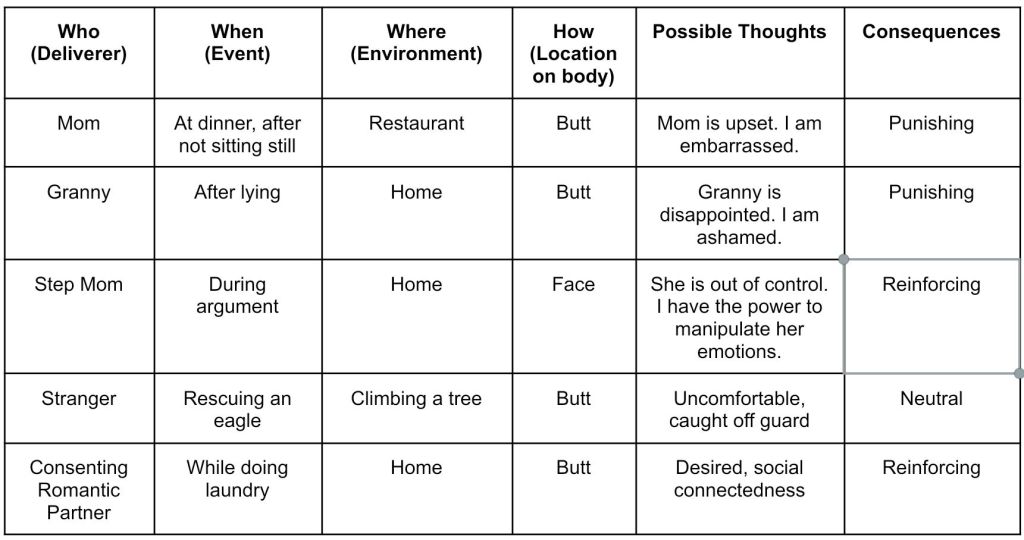
Keep in mind the examples above are from my personal perspective of being on the receiving end and the same situations may have different impacts for you.
The next criteria that is evaluated when describing consequences is if the consequence adds or removes something from the environment or person. When the consequence adds something we say it is positive (adding) and when it removes something we say it is negative (subtractive). This criteria can also seem to contradict itself as the addition of one thing may remove another or visa versa.
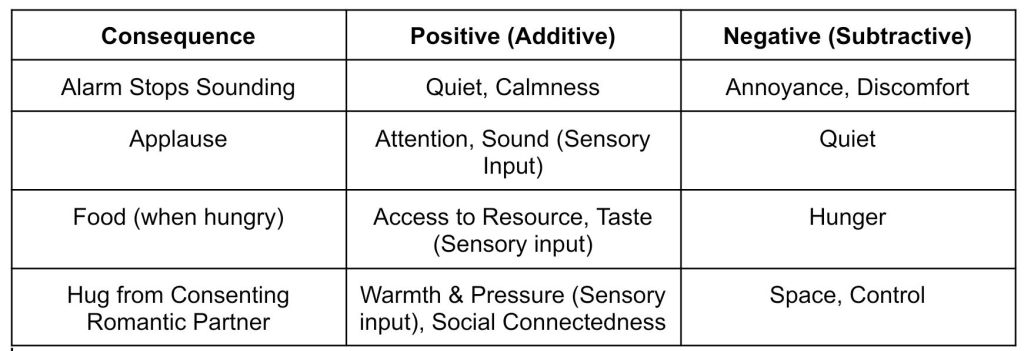
While we define the first criteria based on its impacts on the receiver, the second criteria is typically defined based on the intention of the deliverer, but we should always remember the balance of give and take when evaluating behavior modification and the function or reason a consequence drives the behavior.
Now we can explore a few examples of an everyday contingency, the consequences and how they could impact behavior.
Contingency/Scenario Part 1: IF a seat belt is not buckled THEN a repeating beep of increasing volume will begin.
Person A: This is intended to be aversive and disruptive for most people, by adding an unpleasant sensory experience and is designed to decrease the likelihood that a person remains unbuckled. At this moment it would be described as positive, adding an auditory element, punishment decreasing the likelihood that the person stays unbuckled.
Person B: A child in my life finds the repeated escalating beeps to be a desired auditory input. This results in the same contingency having much different consequences. In this instance the addition of the beep is desired and therefore likely to increase the probability that he will leave off or disconnect his seat belt so it would be said to be positively reinforcing the behavior of remaining unbuckled.
In both of these examples the consequence of the beep is added making it positive but the impact changes based on the person.
Contingency/Scenario Part 2: IF you buckle your seat belt THEN the alarm ceases.
At this moment the alarm stopping would be described as negative, however once again its impact differs based on the person, changing the way it is described.
Person A: The removal of the undesired sound increases the likelihood that they wear their seatbelt in the future, negatively reinforcing the behavior of wearing a seat belt.
Person B: The beep stops and he loses access to the desired sensory input and decreases the chance that he will leave his seat belt on. In this case the beep ceasing would be described as being negative punishment as it uses the removal of a consequence, the beep, to reduce the behavior, wearing his seat belt.
Now I want to introduce a third person and result:
Person C: Granny’s hearing aids are dead and she is unaffected by the beeping. In this case it would not have an impact and therefore be neutral as it would not effect a change in her behavior.
When you are evaluating behavior, think about what contingencies there are and the consequences that occur. As we move forward in this series on behavior science we will look even closer at the complexity of contingencies and consequences. When we are learning science we start by learning the most simplistic, black or white parts however this world is not black and white, it is full of color and so is science. Science is so much more complex than this or that and behavior science is no different. Oftentimes we have to collect data, reevaluate, hypothesis, test and repeat. Even though the science is simple, the practice isn’t always easy but the benefits to modifying behavior in positive ways is worth the effort you apply.



Leave a Reply