

Holding onto Hope

Happiness and hopefulness are not synonymous. Over the last decade I have fought to maintain hope. There have been several points in my life where all hope was gone and I had given up. There are times when hoping for a specific outcome can be harmful and highly unlikely or even unrealistic, hoping your intimate partner will suddenly change and become less violent in an abusive relationship. At some point I will dive much deeper into the science of behavior and we will explore topics like abuse more then. However, hope is often what drives us to keep going. There are inevitabilities in life, such as death, however to quote the Connors, “The future is not set. There is no fate but what we make for ourselves.”

Having hope is different from being positive and allowing “fate” or “faith” to take control. Blind positivity without the drive to change the future is toxic. Everything isn’t wonderful. Humans are struggling to live safe quality lives, our planet is experiencing extreme changes, and we continue to practice blind toxic positivity. It will all work out, just have faith…

Hope however can drive action. I am disappointed, frustrated, disgusted, worried but hopeful. I believe that we may be losing battles but the war is not over. So how do we make our own fate? By fighting. There are so many ways in which we can continue to fight for a fate we design rather than succumb to whatever may occur if left unchecked.

When we think of those fighting wars, they are people who have agreed to give up everything for their cause, but don’t worry, you don’t have to give your comfort, safety or life to make gains. No one person can single handedly save the world, however, millions of people making small changes can have a huge impact.

The war you choose to battle right now might not even be world impacting yet. There have been times in my life when I had neglected my own needs to the point that I was fighting to stay alive. Some of the small changes that I had to commit to may have been as simple as getting out of my bed everyday, even if that just meant relocating to the couch. Once that became a habitat I could begin working on reconnecting with others or engaging my brain in something other than ruminating. Each little change built up to allow me to get back on my feet.

My current personal war is living MY life. I have spent most of my life taking care of others to the point of sacrificing my own wants and higher needs. Thus far I have done things I enjoy- reading more, dinner or drinks with friends, etc. However, there are many things that feed my passions that I have avoided because others feared for me doing them alone- getting out in my kayak, hiking, and exploring new places. While I would absolutely love to share these adventures with someone, I am going to start doing them for myself even if that means by myself, regardless. I am done forcing myself to be what others want from me and am going to live my life authentically and while doing this hopefully find my people along the way.
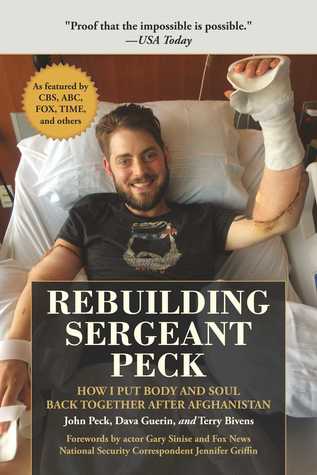
Bibliotherapy- Rebuilding Sergeant Peck: How I Put Body and Soul Back Together After Afghanistan

Title: Rebuilding Sergeant Peck; How I Put Body and Soul Back Together After Afghanistan 

Author: John Peck, Dava Guerin, and Terry Bivens 

Genre: Non-Fiction, Memoir 

Length: 216 Pages 

Publish Date: 2019 

Tags/Triggers: Mental Health, Military Service, Suicidal Ideation, Physical Injury, Traumatic Brain Injury 

Born in 1985 to a single mom, John Peck was destined for military service. Throughout his childhood he remained resilient despite repeated physical and emotional abuse, family financial struggles and homelessness. However, he continued to persevere and achieve his dreams. In 2005, Peck joined the Marines. Little did he know just how much it would change his life, in ways he could never have imagined.  

Not long after enlisting, Lance Corporal Peck was sent on his first deployment to Iraq. There he spent his time patrolling the area in order to network with the locals and complete searches to gather intelligence on terrorist cells. During one of these patrols his vehicle rolled over a pressure plate triggering an improvised explosive device (IED). This incident resulted in a traumatic brain injury (TBI) that promptly ended his deployment and nearly ended his military career. 

The TBI that Lance Corporal Peck received caused much more than just momentary confusion. He spent years undergoing evaluations and rehabilitation to learn how to live with the resulting memory and motor damage. With lots of hard work and support, he was able to prove that he was still capable of being a fully functioning Marine with minimal accommodations. In 2009, he reenlisted with the hope of once again being deployed and a year later was sent to Afghanistan.  

On May 24th John stepped squarely on a missed device and instantly lost both legs and his right arm. While his left arm was still attached, it was severely injured which would eventually result in it too being surgically removed. 

John spent months being stabilized. Every conscious moment, he begged the medical staff to let him die. Between the pain and reality of his new disability he could not imagine there was any purpose in his life. It wasn’t until he witnessed others overcoming similar injuries and living fulfilling lives that he began to see a future for himself as well.  

He began to build his network of support, and the more people he connected with the more meaning he saw in his life. When he realized that leaving his darkness behind was helping others do the same, he became even more motivated to regain his independence. As he began to be an active participant in his treatment, he earned a new rank: Sergeant. In this leadership role, he reflected on all the trauma he had overcome thus far and was determined to dig within himself and awaken that same perseverance and resilience he’d had as a child. John began to advocate for himself and take his new challenges head on, leading to his to becoming the first successful recipient of a double arm transplant. 

Rebuilding Sergeant Peck; How I put Body and Soul Back Together After Afghanistan reminds us that despite the complexities that come with managing disabilities everyone is capable of living a fulfilling and purposeful life. It is a great read for anyone facing challenges in their lives be they physical, such as the loss of a limb, or mental, such as depression and anxiety. I recommend it to anyone who is looking for an inspirational page turner. “Rebuilding Sergeant Peck; How I put Body and Soul Back Together After Afghanistan” challenged me to look for opportunities for growth within problems I experience and to recognize that life is more than the events that make it up. It is okay to feel despair in the face of suffering, yet remember that it is only a part of your story. Life doesn’t always happen the way we expect, and living with that uncertainty is something we all have face.  

As an Amazon Associate I earn from qualifying purchases of the items linked in my post.

Bibliotherapy

The Oxford Dictionary defines bibliotherapy as “the use of books as therapy in the treatment of mental or psychological disorders.” While at the surface it may just sound like a fancy word for reading self-help books, it is much more! Bibliotherapy the practice, has been around longer then the word itself. In ancient Greece libraries were known as places to heal the soul. Ancient Greeks embraced the power of catharsis. Today many people unknowingly practice bibliotherapy and several mental health professionals utilize it with their clients.  

Reading can be therapeutic in a number of ways. Not only can we learn skills and strategies to overcome obstacles when we read, we can also safely explore emotions, feel validated and connected, and more. Not every book provides the same experience for every reader, the more we identify with the characters or scenarios the more beneficial it tends to be.  

Reading can absolutely be a form of self-care and I will be sharing with you things that I have read and found to have potential therapeutic benefit. While bibliotherapy is something you can explore independently there is the chance that certain books could trigger difficult feelings. In all my reviews I will list things that I have identified as possible triggers. If while reading if you become overwhelmed please do not hesitate to reach out to a professional to help you through processing your feelings.  

Bibliotherapy Book Reviews

Website Powered by WordPress.com.

Up ↑