
People Pleaser Problem

Why did I stop writing? Why did I ever start? 

I started therapy when I was just 6 years old. I don’t remember a ton about the modality or any positive changes that came from that first therapist. I do recall her explaining to me that I could trust her, that she would keep my secrets and help me. And then I remember the backlash and broken trust. She had been subpoenaed to court as a witness in the incredibly vicious custody battle that was just beginning to sink its vindictive claws into my little life. “Family” at the time in history was presented as this happy unit of people who loved each other unconditionally, who stuck together through thick and thin, defended each other and were permanent. I had never heard of a chosen family, had no examples of what divorce was or could look like. I was alone in uncharted territory. 

Divorce at that time was still so taboo that even other authoritative adults in my life weren’t sure how to respond. In school I was pulled from my class weekly by the guidance counselor to monitor how I was coping I guess. I can tell you not well, I recently found one of my notebooks from 1993, when I was 7 years old, and my “art” is disturbing. Why have I held onto it? I guess it is a reminder of who I am and how far I have come. The adults at school weren’t the only ones unsure of how to handle the situation, I was excluded from extra-curricular activities at church. They couldn’t stop me from attending but they could and they did prohibit me from being an active participant in both the youth group and youth choir, isolating me from my peers. 

Other kids didn’t know how to act either. I was taxied back and forth, weekly, between two houses more than 7 miles apart, in two different zip codes, two different school zones, too far to walk or bike between. My father rarely allowed me to go anywhere I was invited during “his time” and very quickly the invitations just stopped altogether. I was again isolated. 

His time was so valuable because that is when he had full control. The ability to say what he wanted without witness, the only reason I can think of even now was to utilize me as a pawn in his war against my mom. To this day I can not fathom how such hate exists. There are people who make me shudder, who cause a visceral reaction, and even people that strike such fear into me that I flee and yet, I can’t find the capacity to hate. I don’t even hate him, even after he erased me from his family tree. 

I sometimes wish that as easily as he omitted me from his records that I could do the same. Undo the neural pathways he laid ever so carefully. Untangle my twisted automatic thinking. However, it is not possible to erase such trauma and now most days I would not give up my past, it has shaped not only my struggles but also informed my victories.

I have however spent years, decades really, trying to learn how to undo the damage and retrain my brain. I have lost count of how many professionals I have seen. Some only once as they did not inspire a sense of safety in me. Others I saw for months or years at a time. The most impactful moment came in 2018 when my psychologist at the time, Dr. Martin Cohen, told me to “stop being so damned selfless”. I immediately began to pile on my self-deprecation and cite how he was right, my father was right, I was selfish and worthless. Selfish for never giving enough, being enough, for anyone, absolutely worthless. Dr. Cohen would not stand down. He immediately met me with a counter argument. As a way to try and overcome the isolation I dealt with for oh so many years I had become a persistent people pleaser. I did whatever everyone else expected from me, pushed down anything I wanted if it didn’t align to what others around me desired. I had given up me, who I really was, my actual authentic self to try and build connectedness, a sense of love and belonging. The problem was no one, not even me, knew me. This person that was trying so hard to not to stay alone, not die alone like she had been told she would so many times, wasn’t actually me. I was still alone and felt that loneliness to my core. 

That realization is what started me on a new journey. I started graduate school and sought out to discover who I was and what I wanted for the first time in a very, very long time. In graduate school I met many people who had demons similar to mine and so I started writing. 

My writing was a form of self discovery, catharsis, and an outstretched hand to anyone else fighting to not just stay alive, but live a life worth living, a meaningful and connected life. I wanted everyone else like me to know that they belong, WE belong and are worthy of connection, love and happiness. 

So why stop? Once again I had forgotten about me. No one was taking my hand and I had fallen into the old habitats of people pleasing and measuring my worth based on the acceptance of others. I forgot why the journey began in the first place. Here I am though, sitting surrounded by people and yet feeling alone, on the beach, watching a pair of dolphins play as the sunsets and crying as I recommit myself to me, rejection be damned. As a coworker recently told me, if people don’t stand by me in the rain, they don’t deserve me when the sun shines either. 

I may not have many friends but I do have a few really great people who love me, real me, actual authentic raw, rainy days included me.  And I am going to try to accept rejection with more grace. Rejection does not reflect on me but so many things and I am going to try to embrace those awkward moments when I reach out to try and build connections and community yet my hand stays empty or gets pushed away. Those people who get to know me and still love me mean so much more than all of the forced false friendships in the world.

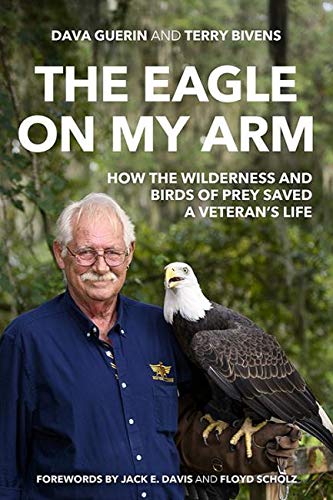
Bibliotherapy: The Eagle on My Arm

Title: The Eagle on My Arm: How the Wilderness and Birds of Prey Saved a Vietnam Veteran’s Life
Author: Dava Guerin, and Terry Bivens 
Genre: Non-Fiction, Memoir 
Length: 200 Pages 
Publish Date: 2020
Tags/Triggers: Mental Health, Military Service, Suicidal Ideation, Physical Injury, Sexual Assault, Depression, Animal Death, Death 

For months I have anticipated the release of “The Eagle on My Arm”. I was excited to write a post about this book and the bibliotherapy benefits of it. What makes this book so difficult for me to write about is how close to home it hits for me. Actually, it is home for me.

“The Eagle on My Arm” is the memoir of my mentor, Patrick Bradley. Patrick is a Vietnam Veteran with severe PTSD. When he first returned from war however PTSD was not well understood and he was just labeled as aggressive and troubled. Fortunately one of the practitioners at Walter Reed was an advocate for those soldiers who were “damaged goods” and pushed for Patrick to be given an opportunity to reintegrate into the civilian world.

Going directly into the public again was not possible, so instead he spent years in the wilderness studying bald eagles. This time in the wild helped him become grounded and develop coping skills. The impact nature had on his journey to healing wouldn’t be fully appreciated however until years later when his son, Skylar, returned from war with his own demons. Patrick did the only thing he knew of to help his son and got him working with birds. It didn’t take long for Patrick to realize just how powerful reconnecting with nature can be.

This book follows his story and includes part of mine. We hope that through sharing our stories and battles it will help reduce the stigma related to mental health and encourage others to seek treatment as well. It also serves as a preface to our next chapter, where we will be opening an ecotherapy center making services increasingly accessible to those with depression, anxiety, trauma-related disorders and other mental illnesses and disabilities because we believe no one should have to face their demons alone.

Bibliotherapy- Rebuilding Sergeant Peck: How I Put Body and Soul Back Together After Afghanistan

Title: Rebuilding Sergeant Peck; How I Put Body and Soul Back Together After Afghanistan 

Author: John Peck, Dava Guerin, and Terry Bivens 

Genre: Non-Fiction, Memoir 

Length: 216 Pages 

Publish Date: 2019 

Tags/Triggers: Mental Health, Military Service, Suicidal Ideation, Physical Injury, Traumatic Brain Injury 

Born in 1985 to a single mom, John Peck was destined for military service. Throughout his childhood he remained resilient despite repeated physical and emotional abuse, family financial struggles and homelessness. However, he continued to persevere and achieve his dreams. In 2005, Peck joined the Marines. Little did he know just how much it would change his life, in ways he could never have imagined.  

Not long after enlisting, Lance Corporal Peck was sent on his first deployment to Iraq. There he spent his time patrolling the area in order to network with the locals and complete searches to gather intelligence on terrorist cells. During one of these patrols his vehicle rolled over a pressure plate triggering an improvised explosive device (IED). This incident resulted in a traumatic brain injury (TBI) that promptly ended his deployment and nearly ended his military career. 

The TBI that Lance Corporal Peck received caused much more than just momentary confusion. He spent years undergoing evaluations and rehabilitation to learn how to live with the resulting memory and motor damage. With lots of hard work and support, he was able to prove that he was still capable of being a fully functioning Marine with minimal accommodations. In 2009, he reenlisted with the hope of once again being deployed and a year later was sent to Afghanistan.  

On May 24th John stepped squarely on a missed device and instantly lost both legs and his right arm. While his left arm was still attached, it was severely injured which would eventually result in it too being surgically removed. 

John spent months being stabilized. Every conscious moment, he begged the medical staff to let him die. Between the pain and reality of his new disability he could not imagine there was any purpose in his life. It wasn’t until he witnessed others overcoming similar injuries and living fulfilling lives that he began to see a future for himself as well.  

He began to build his network of support, and the more people he connected with the more meaning he saw in his life. When he realized that leaving his darkness behind was helping others do the same, he became even more motivated to regain his independence. As he began to be an active participant in his treatment, he earned a new rank: Sergeant. In this leadership role, he reflected on all the trauma he had overcome thus far and was determined to dig within himself and awaken that same perseverance and resilience he’d had as a child. John began to advocate for himself and take his new challenges head on, leading to his to becoming the first successful recipient of a double arm transplant. 

Rebuilding Sergeant Peck; How I put Body and Soul Back Together After Afghanistan reminds us that despite the complexities that come with managing disabilities everyone is capable of living a fulfilling and purposeful life. It is a great read for anyone facing challenges in their lives be they physical, such as the loss of a limb, or mental, such as depression and anxiety. I recommend it to anyone who is looking for an inspirational page turner. “Rebuilding Sergeant Peck; How I put Body and Soul Back Together After Afghanistan” challenged me to look for opportunities for growth within problems I experience and to recognize that life is more than the events that make it up. It is okay to feel despair in the face of suffering, yet remember that it is only a part of your story. Life doesn’t always happen the way we expect, and living with that uncertainty is something we all have face.  

As an Amazon Associate I earn from qualifying purchases of the items linked in my post.

Website Powered by WordPress.com.

Up ↑