What is Driving Your Behavior?

Regardless of my job title, there is one fundamental aspect that seems to be a through thread and that is understanding behavior. What is behavior exactly? Behavior is the observable and measurable things that an organism does, in this post we will be talking about people. Most behaviors that come to mind first are overt, or able to be easily observed by others, behaviors can also be covert and only easily observed by the individual doing them, such as thinking. Every behavior serves a purpose or function that can be linked back to our basic needs. 

In 1943, psychologist Abraham Maslow theorized a hierarchy of needs in his paper “A Theory of Human Motivation”. He presented these needs as a tiered system and hypothesized that in order for higher level needs to be addressed, lower level needs must first be fulfilled. The most basic of needs include our physiological needs such as air, nutrition, hydration, rest, temperature regulation and waste removal. These basic needs are required to maintain life in general but as we begin to move up the hierarchy the needs increase the quality of life. The next level addresses our safety needs; these include access to resources, shelter, control, structure, etc. Once we feel safe and secure we can focus on our social needs like a sense of belonging, community, connection, friendships, and intimacy. With connection and a sense of love and belonging we begin to develop our self-esteem and everything beyond that which includes growth and self-actualization. It was initially theorized that these needs had to be met at each level before progress at the next level could occur, however, as we have learned progress is not linear and multiple levels can be addressed simultaneously or even compete with each other.   

Behaviorists use the term function to describe the reason a behavior occurs so lets see how these needs fall into place with these functions. The four functions are access to resources, attention, escape, and sensory. When teaching animal trainers how behavior works many of them get stuck on access to resources and specifically nutrition. As we will be exploring, what drives our behavior is much more complex than just food, and we will start by unpacking what all access to resources includes. 

When discussing access to resources as a function of behavior we are talking about tangible items that move us toward fulfilling some of those basic needs including physiological needs (nutrition, hydration, thermoregulation), social needs (other individuals or groups), self-care (bathing, clean clothes, comfortable place to rest) and even growth (entertainment and learning). 

The next function we are going to explore is attention. Attention addresses the need for social connectedness and for people is most frequently desired from other people. Attention could be presented in various different ways, visual attention such as being observed or watched by others or interactions online, auditory attention like applause or cheering, and even social as in being included or sharing space. 

Both attention and access to resources could also fulfill a sensory function. When we talk about sensory we mean pleasure and pain. This can occur through any of the senses; things we hear, see, taste, smell, and or touch. 

The final function is escape. Escape can happen in opposition to any of the previous functions we discussed. Escape is when we are attempting to avoid something that we find aversive or to simply exert control.

When we understand these functions we are able to better analyze the reason(s) a behavior occurs and potentially identify ways in which we can modify our behavior. In the future I will be diving deeper into the science of behavior and attempting to make it accessible to anyone with an interest. My goal is not to teach you how to manipulate others but rather take control of yourself and work on modifying your own undesired behaviors or forming new positive habitats. I know that some of the science may be a dense read and if you have any questions or would like additional clarification feel free to leave a comment and I will work through it with you.


Holding onto Hope

Happiness and hopefulness are not synonymous. Over the last decade I have fought to maintain hope. There have been several points in my life where all hope was gone and I had given up. There are times when hoping for a specific outcome can be harmful and highly unlikely or even unrealistic, hoping your intimate partner will suddenly change and become less violent in an abusive relationship. At some point I will dive much deeper into the science of behavior and we will explore topics like abuse more then. However, hope is often what drives us to keep going. There are inevitabilities in life, such as death, however to quote the Connors, “The future is not set. There is no fate but what we make for ourselves.”

Having hope is different from being positive and allowing “fate” or “faith” to take control. Blind positivity without the drive to change the future is toxic. Everything isn’t wonderful. Humans are struggling to live safe quality lives, our planet is experiencing extreme changes, and we continue to practice blind toxic positivity. It will all work out, just have faith…

Hope however can drive action. I am disappointed, frustrated, disgusted, worried but hopeful. I believe that we may be losing battles but the war is not over. So how do we make our own fate? By fighting. There are so many ways in which we can continue to fight for a fate we design rather than succumb to whatever may occur if left unchecked.

When we think of those fighting wars, they are people who have agreed to give up everything for their cause, but don’t worry, you don’t have to give your comfort, safety or life to make gains. No one person can single handedly save the world, however, millions of people making small changes can have a huge impact.

The war you choose to battle right now might not even be world impacting yet. There have been times in my life when I had neglected my own needs to the point that I was fighting to stay alive. Some of the small changes that I had to commit to may have been as simple as getting out of my bed everyday, even if that just meant relocating to the couch. Once that became a habitat I could begin working on reconnecting with others or engaging my brain in something other than ruminating. Each little change built up to allow me to get back on my feet.

My current personal war is living MY life. I have spent most of my life taking care of others to the point of sacrificing my own wants and higher needs. Thus far I have done things I enjoy- reading more, dinner or drinks with friends, etc. However, there are many things that feed my passions that I have avoided because others feared for me doing them alone- getting out in my kayak, hiking, and exploring new places. While I would absolutely love to share these adventures with someone, I am going to start doing them for myself even if that means by myself, regardless. I am done forcing myself to be what others want from me and am going to live my life authentically and while doing this hopefully find my people along the way.

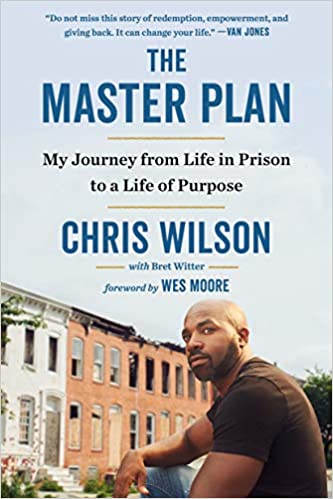
Bibliotherapy- The Master Plan: My Journey from Life in Prison to a Life of Purpose

Title: The Master Plan: My Journey from Life in Prison to a Life of Purpose 

Author: Chris Wilson 

Genre: Non-Fiction, Memoir 

Length: 414 Pages 

Publish Date: 2019 

Tags/Triggers: abuse, addiction, alcohol, bullying, cancer, child abuse, death, domestic violence, drugs, emotional abuse, incarceration, murder, physical abuse, rape, self-harm, terminal illness, violence 

Growing up Chris Wilson witnessed things no child should ever see. His mother was brutalized and descended into addiction. The neighborhood around him became a war zone and he saw people he loved gunned down. After a while he felt like his choices were fight or die. Then one night he did just that and ended up with a life sentence for murder.  

He was very fortunate to be placed at the prison in Patuxent where the youth inmates were housed separate from the adults. Patuxent also had unique opportunities for offenders to participate in educational programs and counseling. Access to this program allowed Chris to begin to heal and formulate his master plan. This master plan answered his burning question, “What’s your endgame?” Even behind bars with a life sentence all people wonder why they are here, on this planet. 

Chris’s plan began as a bucket list filled with experiences such as “grow a big-ass beard” and attending a bull fight. As he continued to heal and learn his plan evolved and became much more purposeful. Even before he could see light at the end of the tunnel he found light in his life through purpose. He worked incredibly hard without the promise of external pay off just “positive delusions”. His hard work eventually did lead to the opportunity of reward and turned his delusions to reality.  

With the support of caring people around him he managed to get his sentence reduced. He was one of the few to reap rehabilatative benefits from his time in prison. When he earned his release he continued to work hard and give back. He has devoted his life outside to helping keep others out. He has developed systems and supports to improve the culture of the neighborhoods that traditionally acted as pathways to prison.  

The Master Plan: My Journey from Life in Prison to a Life of Purpose was an amazing read that was hard to set down. It is a stark reminder of the deep deficits that plague our country. There are huge inequalities that must be addressed and Chris Wilson is working to do just that. His actions should not end with him but should rather act to inspire and influence others to make positive changes.   

As an Amazon Associate I earn from qualifying purchases of the items linked in my post.

Website Powered by WordPress.com.

Up ↑