PTSD, What is it?

I was recently told, by a journalist, with no credentials related to mental health, that I have PTSD. He had mistakenly and ignorantly diagnosed me based on his lay men knowledge. He assumed that because I have experienced trauma and deal with depression and anxiety that I MUST have PTSD. As I tried to explain to him the differences in diagnoses I realized that too often mental health condition terms get used incorrectly and so casually that some people think they understand, but they don’t.

I could, and will, write an entire post on the how language impacts the stigma related to mental health, but right now I am just going to focus on educating about what PTSD really is.

PTSD, or Post-Traumatic Stress Disorder, is a condition that can be diagnosed at any age and it is listed under Trauma- and Stressor- related disorders in the Diagnostic and Statistical Manual of Mental Disorders, 5th Edition (DSM-5). While it can be diagnosed in children under 6, I am going to focus on how it manifests in those 6 years and older (including adults). I urge you to seek professional help if you or someone you know is struggling with mental health and want you to understand the purpose of this post is general education and awareness and should NOT be used to make assumptions about diagnosis.

This first criteria that must be met is experiencing a traumatic event that involves death, potential death, severe injury, or violence. This can be an event that happens directly to the person, was witnessed by the person, or occurs vicariously.

While I have met this criteria it does not mean that I will automatically develop PTSD.

The next criteria is that the individual has intrusive symptoms related to the event. This means they may repeatedly have undesirable memories of the event, flashbacks (moments in which they feel as if the event is occurring again/still), or distress triggered by a symbolic cue linked to the event (this distress could be mental or physical). There must also be continued attempts to avoid triggers and or intrusive symptoms.

The next criteria is negative changes in the way the person thinks or their feelings. Some of the ways this is seen is through self-blaming for the event, inability to remember details from the event, constant negative feelings, lack of desire to do things or inability or difficulty with relationships.

The final criteria is considerable changes in behavior around the event. This may look like becoming aggressive, self-harming, participating in risky behaviors, hypervigilance, easily startled, difficulty concentrating, and or troubles related to sleep.

Now it is important to understand that this is not a short-term experience. Acute Stress Disorder is a similar, but brief condition (that I have experienced first hand). PTSD is persistent, lasting more than a month, and significantly impacts the persons ability to function in important areas of life such as socially.

The other thing to remember is that each individual with PTSD is an individual and their experiences will vary. It presents differently in my friend with medical trauma then my friend who is a domestic violence survivor and her differently then my friend who survived a sexual assault, and she differs from my first responder friends, and each veteran friend experiences it differently too.

Those with PTSD can benefit from several different sources of support including counseling. I cannot encourage you enough- if you are effected by PTSD, seek support. Help seeking is courageous, not cowardly and no one should be battling alone.
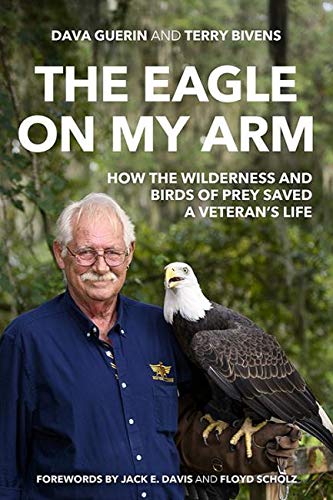
Bibliotherapy: The Eagle on My Arm

Title: The Eagle on My Arm: How the Wilderness and Birds of Prey Saved a Vietnam Veteran’s Life
Author: Dava Guerin, and Terry Bivens 
Genre: Non-Fiction, Memoir 
Length: 200 Pages 
Publish Date: 2020
Tags/Triggers: Mental Health, Military Service, Suicidal Ideation, Physical Injury, Sexual Assault, Depression, Animal Death, Death 

For months I have anticipated the release of “The Eagle on My Arm”. I was excited to write a post about this book and the bibliotherapy benefits of it. What makes this book so difficult for me to write about is how close to home it hits for me. Actually, it is home for me.

“The Eagle on My Arm” is the memoir of my mentor, Patrick Bradley. Patrick is a Vietnam Veteran with severe PTSD. When he first returned from war however PTSD was not well understood and he was just labeled as aggressive and troubled. Fortunately one of the practitioners at Walter Reed was an advocate for those soldiers who were “damaged goods” and pushed for Patrick to be given an opportunity to reintegrate into the civilian world.

Going directly into the public again was not possible, so instead he spent years in the wilderness studying bald eagles. This time in the wild helped him become grounded and develop coping skills. The impact nature had on his journey to healing wouldn’t be fully appreciated however until years later when his son, Skylar, returned from war with his own demons. Patrick did the only thing he knew of to help his son and got him working with birds. It didn’t take long for Patrick to realize just how powerful reconnecting with nature can be.

This book follows his story and includes part of mine. We hope that through sharing our stories and battles it will help reduce the stigma related to mental health and encourage others to seek treatment as well. It also serves as a preface to our next chapter, where we will be opening an ecotherapy center making services increasingly accessible to those with depression, anxiety, trauma-related disorders and other mental illnesses and disabilities because we believe no one should have to face their demons alone.

The Imposter Inside

Have you ever felt like you were a fraud? Perhaps you questioned your own knowledge in your field or position. Maybe you were anxious that someone would discover that you were just “faking it until you make it.” These are all signs of a phenomenon known as IMPOSTER SYNDROME and you are not alone.

This year has been particularly tough for most people as everyone’s lives changed drastically with the pandemic. This has caused even more people to look critically at themselves. Recently, I myself became nearly paralyzed by imposter syndrome. I started a new, temporary, job in the technical theatre industry, which I haven’t worked in in almost 10 years, launched the internship program at Owl’s Nest Sanctuary for Wildlife, and continued on my own professional development journey as a graduate student. Up until now, I had felt rather comfortable, confident even, in my decision to leave my career as a classroom teacher to purse my Big Audacious Goal of opening an ecotherapy center. Suddenly, however, I felt like I must have flown under the radar to get accepted into my graduate program and that I had made it this far by a streak of good luck. I was terrified that any day now my luck would run out and someone would realize that they had made a mistake and I would be busted as an imposter!

So why on earth would I turn around and out myself like this?

Last week I had a conversation with some of my peers, turns out this feeling is pretty universal and most people experience it at some point. Through talking about my feelings I was able to process what was going on deeper within and gained a better understanding as to why this common condition was flaring up so viscously for me.

For many years I had a deeply rooted belief that I was worthless, useless, and undeserving. It wasn’t until the last few years that I was able to start to breakdown these beliefs by reframing my thinking (I will do a post in the future explaining what that means). I spent the majority of my life discounting myself and my achievements because I didn’t feel or think I was worthy of success and recognition. This affected me to the point that if you thanked me for something as simple as setting up the desks for class, I would reject your appreciation and tell you why I did it for self-serving reasons. As a result of this constant self-depreciation, I have a skewed view of my qualifications and abilities but I am working on changing that. I realized that I have spent my whole life trying to prove my worth and not spent enough time reflecting on the value of everything I have done, accomplished.

Yes, I could continue to discount myself by measuring myself against everything I haven’t done, but there will always be more to do and no one is a master of all things. I am choosing to focus on what I have done rather then what I haven’t. As for the “streak of good luck”, Seneca said, “Luck is what happens when preparation meets opportunity”. This means that if I hadn’t put in the work upfront I wouldn’t be able to seize the opportunities I have when they present.

The only imposter is the voice inside telling me I am not worthy and its time that voice shuts up. I’m making a commitment to myself to spend time each week reflecting on something I have accomplished and recognizing myself for the hard work I did to do it. Sometimes these accomplishments may be small but I will write them each down and when the imposter inside begins to creep back up I will have a quick reference of the evidence proving to myself that I am not a fraud, I am a badass!

What is something you have accomplished that you should give yourself more credit for? Comment below and let’s practice some praise with each other!

As an Amazon Associate I earn from qualifying purchases of the items linked in my post.

Privileged, Me?

As part of my commitment to learn more about how I can contribute to changing systemic discrimination and facilitating uncomfortable conversations I am currently reading So You Want To Talk About Race by Ijeoma Oluo. I am only four chapters in so far, but she has promised that I will make missteps along this journey, and that is okay. One of the frequent mistakes that is made in having conversations about systemic discrimination is forgetting to check your own privilege. Its hard to think of myself as privileged as I grew up in a text book broken home in a working class community with mental illness, but privilege comes in many different forms. Oluo discusses the many ways in which privileges present and encourages reflecting on ones own privileges. She also noted that some privileges may also come with disadvantages in certain ways but they still provide a certain benefit.

So here I go, publicly exploring and checking my own privileges and hoping you will, at least privately, do the same. If I am overlooking a privilege, which is possible, let me know!

I am white.
I am cisgendered.
I lean toward heterosexual norms.
I was able to complete high school.
I was able to afford to attend college and complete my degree.
I am a US born American.
I speak fluent English.
I am child-free.
I have supporting, loving, grandparents, mom, and brother.
I was able to attend preschool.
I am able bodied.
I am back in school working toward my masters degree.
I have stable housing.

I challenge you to comment with at least one way that you have privilege and I hope you will subscribe to my site and join me on this journey to a healthier community and improving mental wellness for all.

I am continuing to collect questions in order to facilitate an ongoing decision about race (Lets Talk About Race) but in the mean time will explore how I can better have these conversations. Next week I will share how we can use our privileges to help challenge systemic discrimination!

As an Amazon Associate I earn from qualifying purchases of the items linked in my post.

Lets Talk About Race

Last week I wrote about how I have grown up in a systemically racist society and therefore occasionally have thoughts that are influenced by racial prejudices. I do not let these thoughts influence my behavior and am hyper aware and ashamed that they exist. I made a commitment to learn more about these systems and uncover ways in which we can work to correct them as well as facilitating and participating in the uncomfortable conversations needed to make these changes.

I have begun to try and talk to those around me and have discovered blind spots that harbor confusion and prevent growth. These are the result of differing life experiences and our personal realities that are based on what we have been told our whole lives. When I ask if anyone had talked to their black friends, coworkers, neighbors, etc. about their experiences and realities I frequently hear “No, I don’t want to come off as offensive.” I recognize that it is an uncomfortable possibility so I am stepping up lead these conversations. I am asking that people submit, anonymously, their questions. I will then work to provide answers to bring about clarity and help remove our systemic blinders.

While some topics I feel that I am capable to address myself, I am building a panel of experts who have grown up with different perspectives and realities then my own to help me with these conversations. I encourage you to subscribe to my site so that you can journey with us to a more inclusive tomorrow.

If you have questions or curiosities you would like us to talk about please submit them at the link below!

Submit your questions

Website Powered by WordPress.com.

Up ↑